A single undetected water leak inside a Doha office tower, retail complex, or industrial facility rarely announces itself loudly. It starts as a damp patch behind a false ceiling, a faint musty smell in a stairwell, or a slightly higher water bill nobody questions. By the time it’s visible, it has usually already damaged finishes, compromised electrical systems, or forced a partial shutdown of operations.
For commercial property owners and facility managers across Qatar, water leakage isn’t a minor maintenance line item—it’s one of the most expensive and most preventable risks a building carries. Kahramaa has reported that technical water losses across Qatar’s national distribution network now sit below 4.5%, a figure the utility describes as among the strongest international efficiency benchmarks in the sector. As a trusted provider of facility management and water leakage solutions in Qatar, Graner works with commercial properties to identify hidden leaks before they become major operational and financial problems.
Drawing on Graner’s experience supporting commercial facilities across Qatar, this guide is built for that gap. It covers the real causes of commercial water leakage in Qatar’s climate, the detection methods that actually catch problems early, repair approaches that hold up under Doha’s heat cycling, the regulatory landscape you’re operating within, and a practical maintenance framework you can hand directly to your facilities team.
1. Why Water Leakage Is a Distinct Risk in Qatar’s Commercial Buildings
Generic water damage guides most of which are written for North American or European climates miss several conditions that make Qatar’s commercial buildings behave differently.
Extreme thermal cycling. Surface temperatures on Doha rooftops can swing by 40°C or more between midday summer heat and overnight cooling. That daily expansion-and-contraction cycle is brutal on waterproofing membranes, sealant joints, and pipe couplings far more aggressive than the wear seen in temperate climates where most generic leak-prevention content originates.
Near-total dependence on mechanical cooling. Commercial buildings across Qatar run HVAC systems almost continuously for eight to nine months of the year. That means condensate drainage isn’t a seasonal concern it’s a year-round structural load on the building, and a failure point that’s active far more often than in markets where AC runs only in summer.
Dense vertical construction. Towers in West Bay, Lusail, and similar high-rise corridors mean a leak originating on floor 22 can travel through risers, shafts, and slab penetrations before surfacing on floor 14. Vertical density multiplies the consequences of a single point failure.
Rare but intense rainfall events. Doha doesn’t get frequent rain, but when storms hit, drainage systems that haven’t been maintained or weren’t sized for current intensity get overwhelmed quickly. which is precisely why Ashghal’s current infrastructure investment is so heavily weighted toward stormwater capacity (more on that in Section 7).
A mixed-age building stock. Qatar’s rapid construction boom over the past two decades means commercial properties range from cutting-edge GSAS-certified developments to older buildings with legacy MEP systems approaching the end of their design life. Leak risk profiles are very different depending on which category your property falls into.
Put together, these conditions mean that water leakage solutions designed for other climates don’t transfer cleanly to Qatar. A maintenance program needs to be built around heat-driven material fatigue, continuous HVAC load, and the realities of high-rise vertical risk not generic seasonal guidance.
2. The Real Cost of an Undetected Leak: Beyond the Repair Bill
When facility managers budget for leak risk, they tend to estimate only the direct repair cost a plumber’s invoice, a patch of drywall, a coat of paint. That dramatically understates the actual exposure.
Structural and finish damage compounds over time. Water that sits undetected for even a few days can warp flooring, delaminate ceiling tiles, corrode structural fasteners, and stain finishes that then need full replacement rather than spot repair.
Electrical risk. Water intrusion near electrical panels, server rooms, or lighting circuits isn’t just a property damage issue it’s a life-safety issue that can force an immediate, costly shutdown of affected zones until systems are certified safe.
Mold and air quality issues. Qatar’s humidity, combined with constant air conditioning, creates near-ideal conditions for mold growth once moisture is trapped behind a wall or above a ceiling tile. Remediation costs and potential occupant health complaints can dwarf the original leak repair.
Business interruption. For retail tenants, office occupiers, or hospitality properties, even a partial closure for repairs translates directly into lost revenue and reputational friction costs that rarely show up in a maintenance budget line but are very real to ownership.
Insurance friction. Commercial property insurers increasingly scrutinize maintenance records when assessing water damage claims. A building with no documented inspection or leak detection program is a far harder sell to an insurer than one with a clear, dated maintenance trail and claims can be reduced or denied where neglect is evident.
This is the financial logic behind investing in leak detection and prevention before a problem appears, rather than waiting to react. It’s the same logic Kahramaa applied at a national scale investing in detection and network renewal specifically because the cost of unmanaged loss compounds over time.
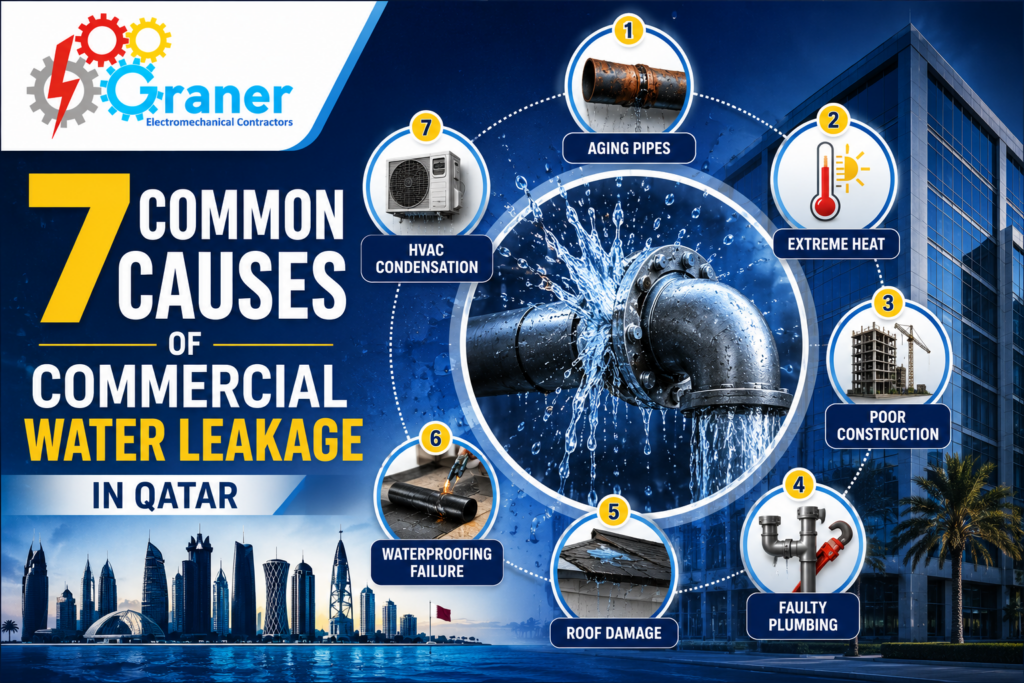
3. The Seven Most Common Causes of Commercial Water Leakage
1. HVAC Condensate Line Failures
This is consistently the leading cause of internal leaks in Qatari commercial buildings. Condensate drain pans crack, lines disconnect at joints, or algae and debris block the drain path entirely backing water up into ceiling voids above occupied space. Because cooling systems run nearly year-round, this isn’t an occasional risk; it’s a constant one.
2. Roof and Waterproofing Membrane Degradation
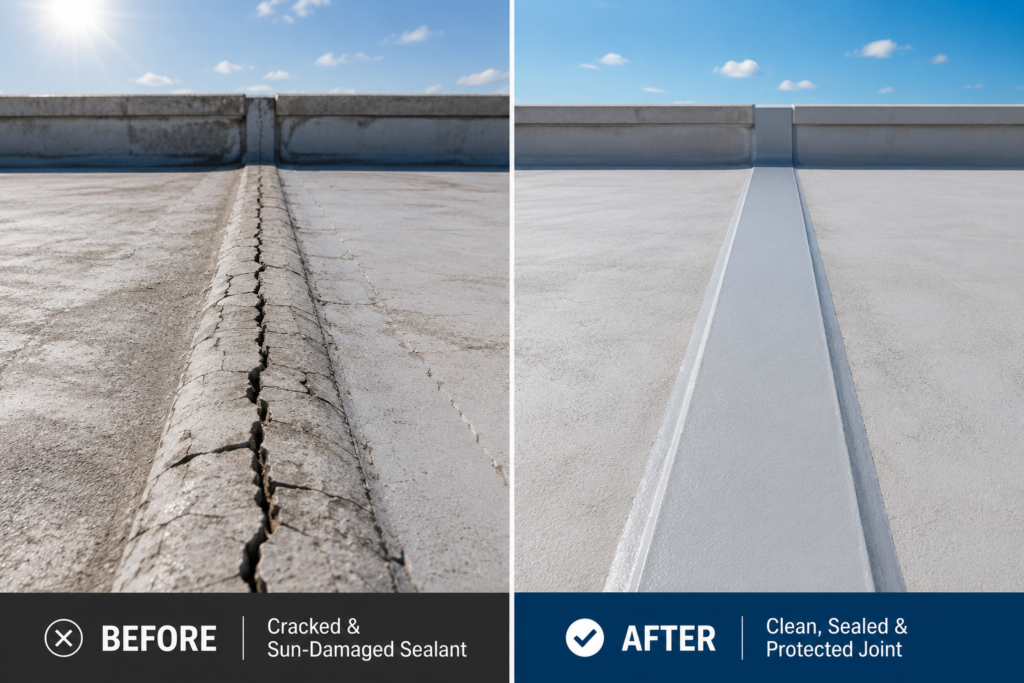
UV exposure and thermal cycling break down bituminous and membrane waterproofing far faster in Doha’s climate than manufacturer specifications (often written for temperate climates) anticipate. Cracking typically starts at parapet flashings, rooftop unit penetrations, and expansion joints.
3. Corroded or Aging Plumbing Risers
Buildings constructed before more rigorous MEP material standards were widely enforced often used galvanized piping that corrodes from the inside out. The failure is invisible until a pinhole leak develops at a joint almost always inside a wall, riser shaft, or above a ceiling.
4. Façade and Curtain Wall Sealant Failure
On high-rise commercial towers, sealant joints around curtain wall panels and window systems are exposed to direct heat, UV, and occasional sandstorm abrasion. Once a seal fails, water intrusion at upper floors can travel significant distances before surfacing visibly.
5. Blocked or Undersized Roof and Surface Drainage
Drains clogged with sand, dust, and debris extremely common in Qatar’s environment — cause water pooling that eventually finds its way through roofing seams or building penetrations rather than draining as designed.
4. How Professional Leak Detection Services Actually Work
Generic advice often stops at “install sensors.” A genuinely effective leak detection program in a commercial building layers several methods, each suited to a different part of the building.
Point sensors in high-risk zones. Discrete flood and moisture sensors placed in mechanical rooms, server rooms, basements, and beneath HVAC units provide immediate alerts the moment water is present before it spreads beyond the immediate area.
Acoustic and pressure-based leak detection for plumbing mains. For buried or in-wall plumbing, acoustic listening devices and pressure-drop testing can identify leak locations without invasive demolition critical in occupied commercial buildings where disruption needs to be minimized.
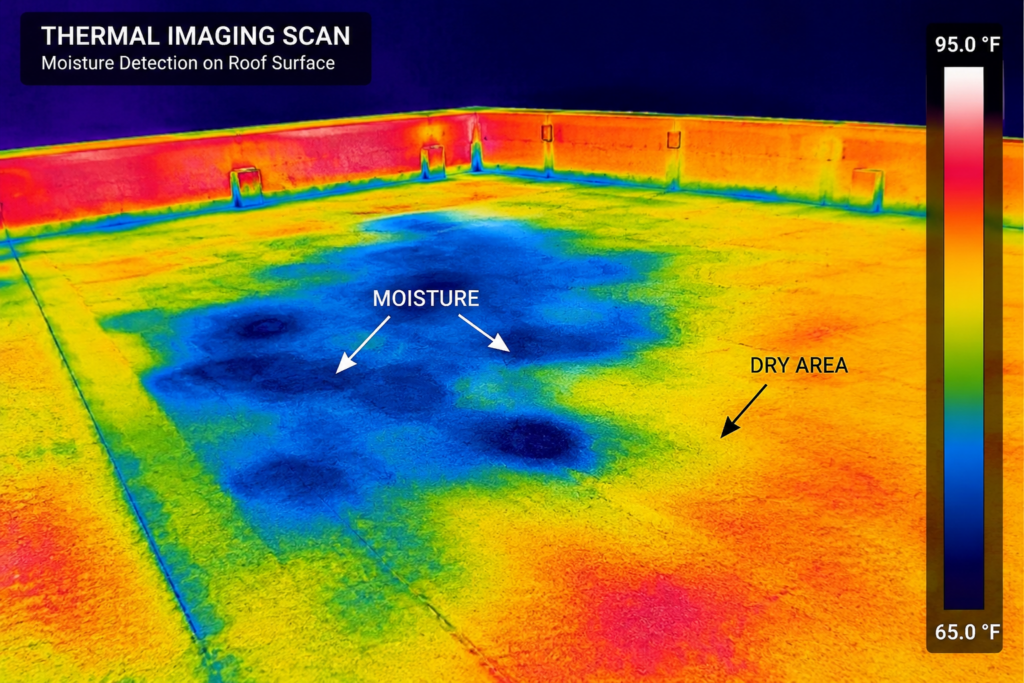
Thermal imaging surveys. Infrared cameras can reveal moisture trapped behind walls or under roofing membranes by detecting temperature differentials invisible to the naked eye particularly effective for roof and façade inspections after Qatar’s hot season.
Humidity monitoring in critical spaces. Gradually rising humidity in a server room or telecom closet is often the earliest indicator of a developing leak, well before any visible sign appears and it’s especially valuable because moisture damage to electronics can be catastrophic and immediate once it reaches a critical threshold.
Smart water metering and consumption analysis. Unexplained increases in water consumption, especially during periods when occupancy hasn’t changed, are one of the most reliable indicators of an underlying leak the same principle Kahramaa applies at a network level through its smart metering and non-revenue water tracking programs.
The combination matters more than any single method. A building with sensors only in mechanical rooms, for example, has no visibility into a façade leak developing on floor 30. A genuinely resilient program covers vertical risk across the whole structure, not just the obvious ground-floor mechanical spaces.
5. Water Leak Repair Services: Matching the Method to the Problem
Not every leak calls for the same repair approach, and one of the most common mistakes in commercial maintenance is applying a generic fix to a problem that needs a more targeted solution.
Spot sealant repair works for isolated façade or rooftop penetration leaks where the surrounding membrane is still in good condition — fast, low-cost, but only appropriate when damage is genuinely localized.
Membrane section replacement is needed when degradation has spread beyond a single point patching alone won’t hold, and a section of the waterproofing system needs full removal and reinstallation.
Pipe relining or targeted section replacement addresses corrosion-related plumbing leaks without the cost and disruption of replacing an entire riser — appropriate where corrosion is localized rather than systemic throughout the pipe run.
Full riser or main replacement becomes necessary once corrosion or material failure is systemic across a plumbing run a larger capital project, but one that prevents recurring emergency repairs on the same line.
Condensate system rebuild is sometimes required where repeated HVAC leaks trace back to undersized or poorly routed drainage rather than a single failed component fixing the symptom repeatedly without addressing design flaws wastes money over time.
A competent water leak repair service should diagnose which category a given leak falls into before quoting a fix — not default to the fastest, cheapest patch regardless of whether it addresses the underlying cause.
6. Plumbing Leak Solutions for Aging Commercial Buildings
Qatar’s rapid development means a meaningful share of commercial stock is now fifteen to twenty-five years old — old enough for original plumbing systems to be approaching or past their realistic service life, but not so old that wholesale redevelopment is typically on the table. That puts the focus squarely on extending system life through targeted intervention.
Pipe material assessment. Before any major plumbing intervention, an accurate assessment of existing pipe material (galvanized steel, copper, or early-generation PVC/CPVC) and its condition should drive the repair strategy — guessing leads to either overspending on unnecessary full replacement or underspending on a patch that fails again within a year.
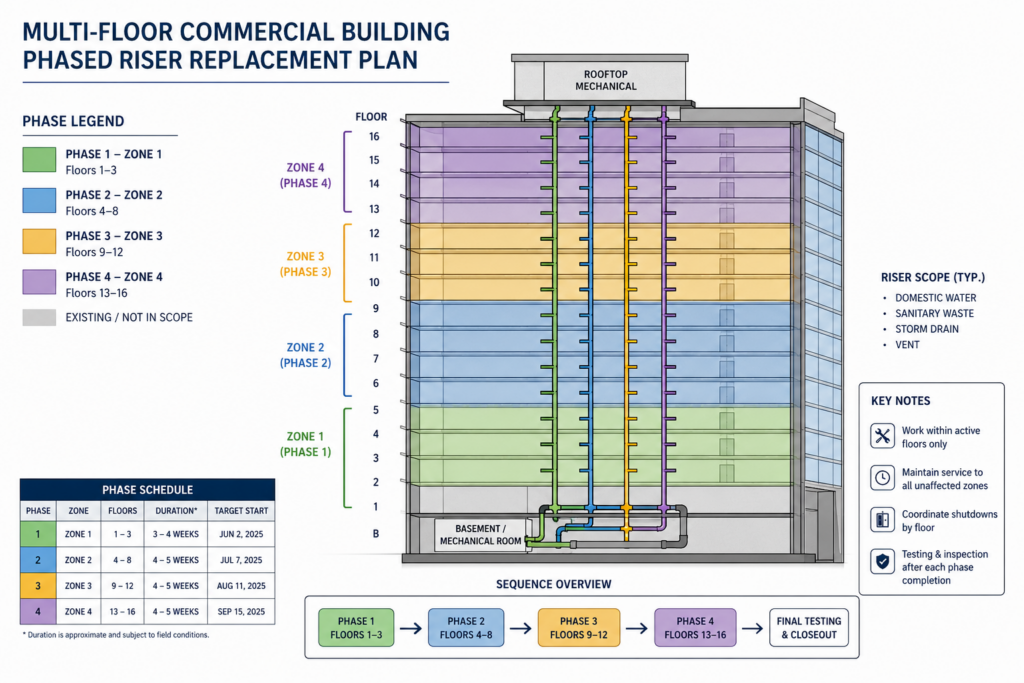
Phased riser replacement. For buildings where full plumbing replacement isn’t immediately viable, a phased approach replacing the highest-risk risers first, based on age, material, and incident history spreads capital cost while still addressing the most urgent failure points.
Backflow and pressure-relief valve checks. Often overlooked, malfunctioning pressure-relief valves and backflow preventers can cause leaks that present as plumbing failures but are actually system-pressure issues fixing the valve resolves what looks like a chronic pipe problem.
Documentation as a maintenance asset. Every plumbing repair, however minor, should be logged with location, cause, and resolution. Over a few years, that record becomes one of the most valuable tools a facility manager has it reveals patterns (a specific riser failing repeatedly, for example) that a single incident never would.
7. Qatar’s Regulatory Landscape: Ashghal, Kahramaa, and GSAS
Understanding the regulatory environment isn’t just a compliance checkbox it directly shapes what “good” water leakage prevention looks like for a commercial building in Qatar.
Ashghal and stormwater drainage standards. Ashghal’s Drainage Affairs department requires surface water runoff to be managed and controlled for all developments, with adequate provision made for storage and attenuation of stormwater runoff meaning a commercial property’s external drainage design isn’t discretionary; it’s governed by formal developer drainage requirements. Ashghal is currently executing a package of 20 infrastructure projects worth more than QR 11.5 billion, with a significant share aimed at enhancing stormwater drainage systems, improving infrastructure network efficiency, and mitigating water accumulation risks — a clear signal of how seriously drainage performance is being treated at the national level, and a useful benchmark for how seriously it should be treated at the building level too.
GSAS and building performance standards. The Gulf Sustainability Assessment System (GSAS) includes water efficiency and building envelope performance criteria that, while focused primarily on sustainability outcomes, indirectly raise the baseline for waterproofing and plumbing system quality in newer commercial developments making leak resilience a byproduct of sustainability compliance rather than a separate concern.
For facility managers, the practical takeaway is this: Qatar’s regulatory direction is unambiguously toward tighter drainage standards, better leak detection, and stronger building envelope performance. Properties that get ahead of that curve rather than treating compliance as a minimum bar tend to face fewer surprises during inspections, insurance reviews, and tenant due diligence.
8. Building a Leak Prevention Program That Actually Holds Up
A genuinely effective program isn’t a once-a-year inspection it’s a structured cycle matched to Qatar’s specific seasonal and operational pressures.
Pre-summer inspection (March–April). Before peak cooling season begins, condensate lines, drain pans, and HVAC plant areas should be fully inspected and cleared this is the highest-leverage inspection window of the year, since it precedes eight months of near-continuous system load.
Mid-summer spot checks (June–August). Brief, targeted checks of the highest-risk zones identified in the pre-summer inspection, catching any early-stage issues before they compound over the remaining cooling season.
Post-summer/pre-rain roof and façade inspection (September–October). With peak heat cycling having done its annual damage, this is the window to assess and repair waterproofing and sealant degradation before Qatar’s main rainfall period.
Annual plumbing system review. A full review of plumbing performance, incident history, and pressure testing results ideally timed to inform the following year’s maintenance and capital budget.
Continuous monitoring, year-round. Sensor-based detection and smart metering shouldn’t be tied to a seasonal schedule they should run continuously, catching issues between scheduled inspections.
Frequently Asked Questions
What are the best water leakage solutions for commercial buildings in Qatar?
The most effective approach combines layered leak detection (point sensors, thermal imaging, smart metering), a seasonal inspection cycle matched to Qatar’s heat and rainfall patterns, and an annual maintenance contract with defined leak response times — rather than relying on any single method in isolation.
How do I know if my commercial building has a hidden water leak?
Watch for unexplained increases in water consumption, musty odors, ceiling or wall discoloration, peeling paint, or rising humidity readings in mechanical and server rooms. Professional leak detection services can confirm hidden leaks before any visible damage appears.
How often should commercial HVAC systems be inspected to prevent leaks?
At minimum quarterly, with closer monitoring during Qatar’s peak cooling months (roughly May through September) when condensate systems run under continuous load.
Are water leak repair services covered under a facility management contract?
Yes, typically. Plumbing and mechanical system management, including leak repair, is usually included within a comprehensive building and tower facility management agreement rather than billed separately as an emergency callout — though it’s worth confirming scope explicitly in any contract.
What causes most water leaks in Doha’s commercial buildings?
HVAC condensate line blockages, façade and roof sealant degradation from extreme heat cycling, and aging or corroded plumbing risers are the most frequent causes in Qatar’s commercial building stock.
Can leak detection services prevent major structural damage?
Yes. Early-stage detection allows repairs before water reaches structural elements, electrical systems, or finished interiors, which significantly reduces both repair cost and business downtime.
Does Qatar have specific drainage regulations commercial buildings must follow?
Yes. Ashghal’s Drainage Affairs requirements govern stormwater management and drainage design for developments, and properties are expected to manage and control surface water runoff with adequate storage and attenuation provisions as part of standard compliance.
How long does a typical commercial water leak repair take?
It depends entirely on the category of repair a spot sealant fix may take hours, while a full riser replacement or membrane section replacement can take days to weeks depending on scope and building access constraints.
Conclusion & Next Steps
Water leakage in commercial buildings is almost never sudden. It’s the end result of a small, unaddressed issue a cracked sealant, a blocked condensate line, a corroding pipe joint left to develop, usually over weeks or months, often invisibly. Qatar’s own infrastructure story makes the case clearly: sustained investment in detection and maintenance, applied consistently, dramatically cuts losses over time. The same logic scales down to a single building with the same result lower repair costs, less disruption, and a longer asset lifespan.
If you manage a commercial, residential, or industrial property in Doha or anywhere across Qatar, Graner’s facility management and MEP teams can assess your building’s leak risk and put a structured, season-matched prevention plan in place before a small issue becomes an expensive one.
📞 Call: +974 44366836
Visit Us: Click here