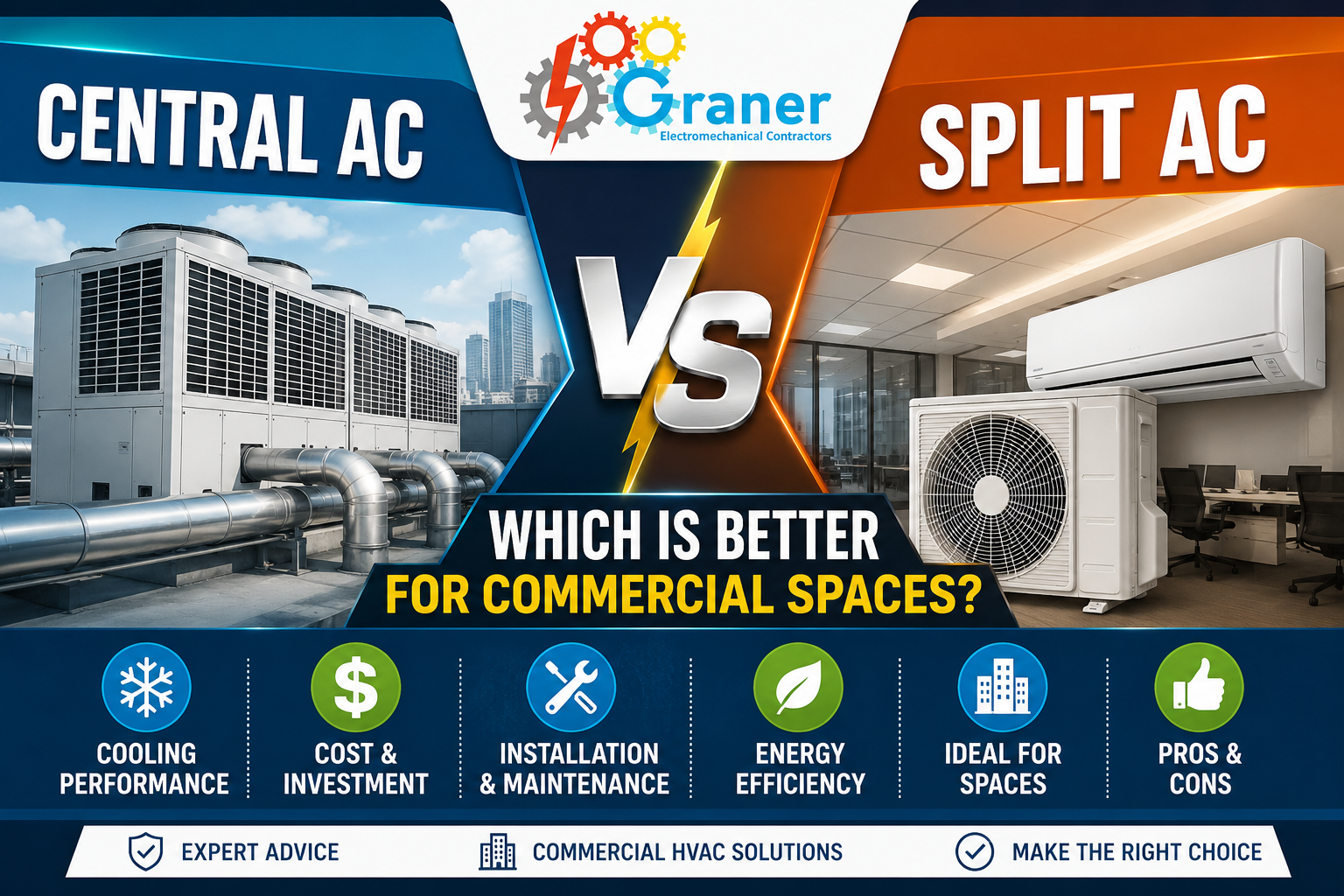
Choosing between central AC and split AC isn’t just a comfort decision when you’re running a business in Qatar it directly affects your energy bills, your maintenance contracts, and how quickly you can get a faulty zone fixed without shutting down operations. With outdoor temperatures regularly crossing 40°C+ for much of the year, commercial cooling in Doha runs almost continuously, so the system you pick has a real, ongoing cost.
This guide breaks down central AC vs split AC specifically for commercial properties offices, retail outlets, restaurants, warehouses, and showrooms — covering cooling coverage, installation, central AC cost, split AC installation cost, and split AC maintenance cost, so you can make a decision backed by numbers, not guesswork.
What Is Central AC? (Commercial Definition)
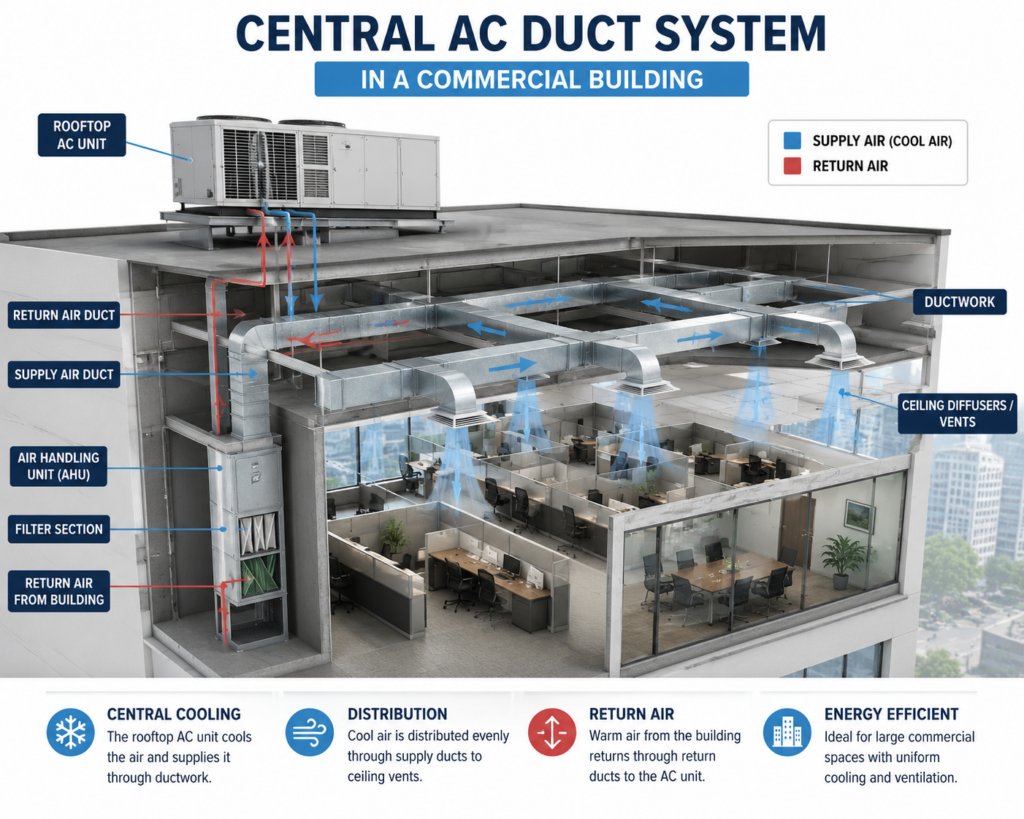
A central air conditioning system uses one large outdoor unit (or a rooftop package unit) connected to a network of ducts that distribute cooled air throughout the entire building from a single point of control. In Qatar, many commercial towers and large retail spaces also rely on district cooling, a building-scale version of central AC where chilled water is piped in from an external cooling plant.
Central AC is built for spaces where the whole floor or building needs consistent, even cooling think large warehouses, supermarkets, showrooms, or open-plan office floors.
What Is Split AC? (Commercial Definition)
A split AC system has two main parts: an indoor unit (wall-mounted, cassette, or ducted) and an outdoor condenser, connected by refrigerant piping — no ductwork required. For commercial use, this typically means:
- Single split units: one indoor unit per room, common in small offices and shops
- Multi-split systems: one outdoor unit running several indoor units, useful for offices with a handful of rooms
- VRF/VRV systems: the commercial-grade evolution of split AC, capable of cooling dozens of zones independently from a shared outdoor system, common in mid-to-large commercial buildings

Commercial Comparison: Central AC vs Split AC
| Factor | Central AC | Split AC (incl. VRF) |
| Best for | Large, open, single-use spaces (warehouses, showrooms, malls) | Multi-zone spaces (offices, retail, restaurants) |
| Temperature control | One zone, one thermostat (unless zoned) | Independent control per room/zone |
| Installation | Major undertaking, needs ductwork — best at construction stage | Faster, less invasive, suited to existing buildings |
| Downtime risk | One fault can affect the whole building | A faulty unit affects only that zone, rest stay operational |
| Energy use | Efficient for full-building, continuous cooling | More efficient when only active zones are cooled |
| Maintenance | Centralized but more complex (ducts, filters, plant room) | Per-unit, generally simpler and faster to service |
| Appearance | Hidden in ceiling/walls, clean look | Visible indoor units on walls or ceilings |
| Upfront cost | Higher, especially with ductwork | Lower per zone, but scales up with more units |
Understanding Commercial AC Costs
Central air conditioning price in a commercial setting depends on several factors rather than a single number:
- Building size and tonnage required: larger floor areas need higher-capacity systems
- Ductwork: if ducts already exist (common in purpose-built commercial towers), installation cost drops significantly; if they need to be added, this is usually the largest cost component
- District cooling connection vs standalone plant: many Doha commercial towers use district cooling, which shifts cost from equipment purchase to a metered service charge
- Zoning equipment: if you want different cooling levels in different sections, this adds to the central AC cost
- Brand and chiller specification
Because commercial central AC pricing varies so much by building type and whether ductwork already exists, the most accurate way to budget is a site survey rather than a generic price list.
Split AC Installation Cost for Commercial Spaces
Split AC installation cost for commercial properties is generally driven by:
- Number of indoor units required: more rooms/zones means more units
- Outdoor unit type: single split, multi-split, or VRF outdoor unit
- Piping run length and complexity: longer copper piping runs between indoor and outdoor units increase labor cost
- Electrical work: dedicated circuits, especially for larger commercial-capacity units
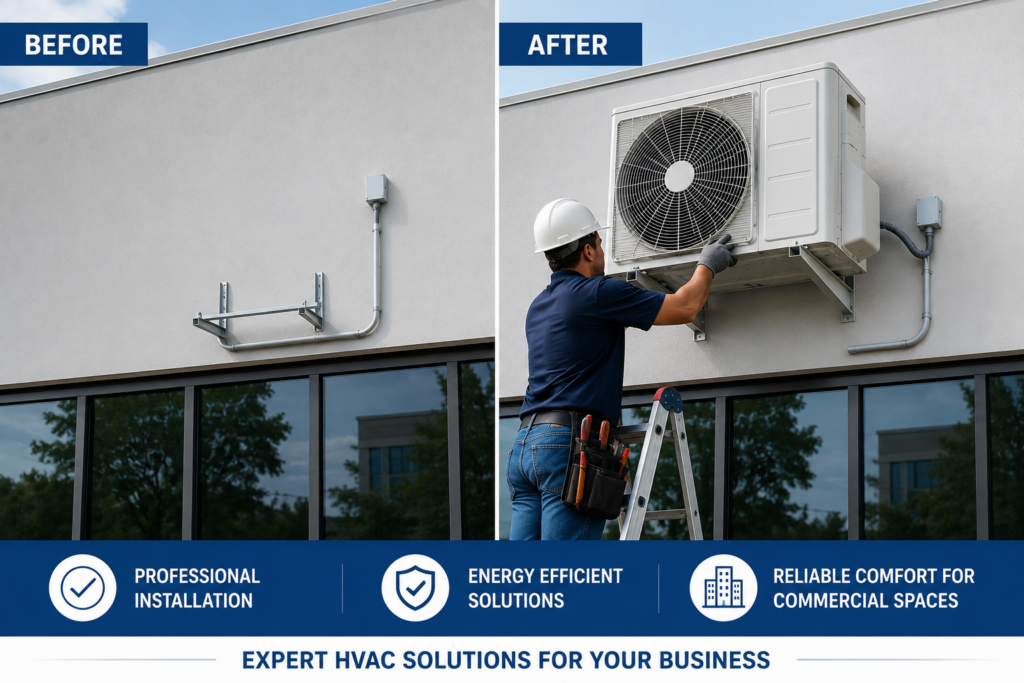
Compared to central AC, split AC installation is faster and less disruptive to daily business operations — a key reason many retail shops and offices in Qatar choose it even after the building is already in use.
Split AC Maintenance Cost for Commercial Businesses
Ongoing split AC maintenance cost for commercial properties is typically structured as an Annual Maintenance Contract (AMC) covering:
- Filter cleaning and replacement
- Refrigerant gas level checks and top-ups
- Coil and condenser cleaning
- Electrical and drainage checks
- Emergency callout response
An AMC is usually more cost-predictable than ad-hoc repairs, and for businesses, it reduces the risk of unexpected downtime during peak operating hours — something a retail store or restaurant can’t afford during business hours.
Which System Is Better for Your Type of Commercial Space?
| Business Type | Recommended System | Why |
| Warehouse / factory floor | Central AC | One large open volume, even cooling priority |
| Shopping mall / showroom | Central AC (often district cooling) | Continuous, building-wide cooling demand |
| Office floor (open plan) | Central AC or VRF split | Depends on whether zoning/flexibility matters |
| Small office / startup | Split AC | Lower upfront cost, fast install, room-level control |
| Retail shop | Split AC | Independent control, easy to install in existing fit-outs |
| Restaurant / café | Split AC | Zone control for kitchen vs dining differs significantly |
| Mixed-use commercial tower | VRF split system | Best of both — centralized efficiency, zone-level control |
Energy Efficiency in Qatar’s Climate
With Doha summers regularly exceeding 40°C, commercial AC systems in Qatar run far longer than in milder climates, which makes operating cost not just upfront cost the bigger long-term factor. Central AC tends to be efficient when a building is fully occupied and cooled continuously, while split AC (and VRF in particular) tends to save energy in commercial spaces with uneven occupancy, since unused zones can simply be switched off. For most multi-tenant or multi-room commercial spaces, this flexibility is what tips the decision toward split or VRF systems despite a higher per-zone install cost.
Why Work With an MEP Contractor Instead of Buying Off-the-Shelf
Commercial AC decisions affect more than comfort they touch your electrical load, building compliance, and ongoing facility budget. An experienced MEP and HVAC contractor can run a load calculation, check existing ductwork or electrical capacity, and recommend central vs split AC the right mix of central and split/VRF systems for your specific floor plan, rather than a one-size-fits-all answer.
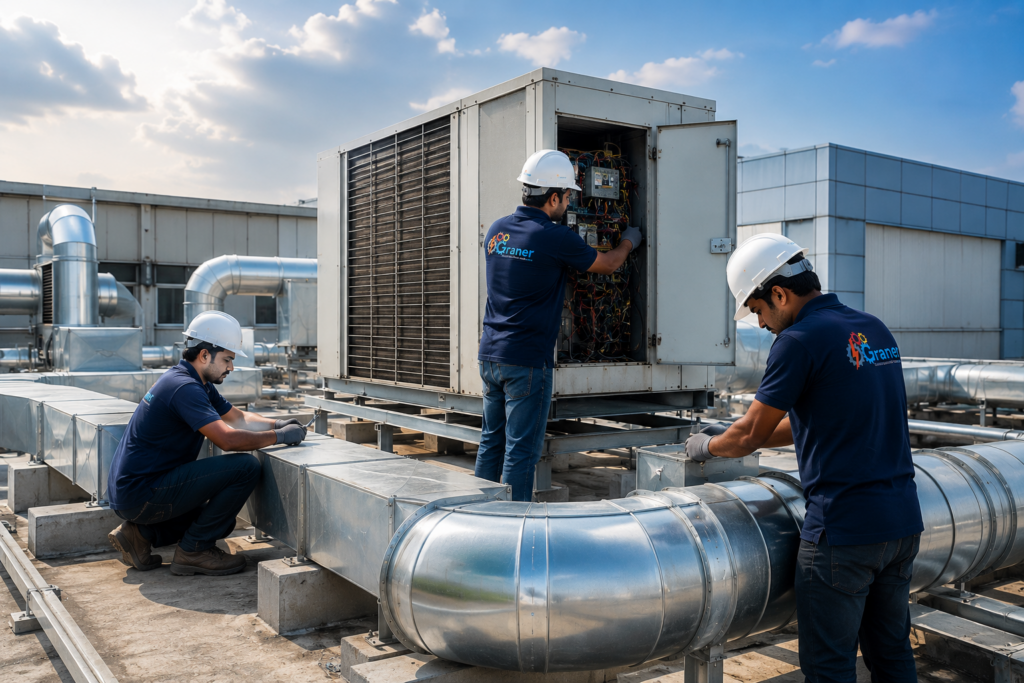
Graner Electromechanical Contractors supplies, installs, and commissions split and window AC systems for commercial properties across Qatar, and provides ongoing HVAC maintenance contracts (AMC) to keep both central and split systems running reliably year-round backed by our wider facility management and MEP project experience across retail, industrial, and commercial sites in Doha.
Frequently Asked Questions
Is central AC or split AC cheaper to install for a commercial building?
Split AC is generally cheaper to install per zone, especially in existing buildings without ductwork. Central AC installation cost is higher upfront but can be more cost-effective per square meter in large, single-use spaces with ducts already in place.
What is the average central AC cost for a commercial space in Qatar?
Central air conditioning price depends heavily on tonnage, ductwork status, and whether the building uses district cooling. The most accurate figure comes from a site assessment rather than a flat estimate.
Does split AC cost more to maintain than central AC for a business?
Not usually. Split AC maintenance cost is typically lower per unit since each indoor/outdoor pair is independently serviceable, while central AC maintenance involves duct cleaning and a more complex plant setup.
Can I mix central and split AC in one commercial building?
Yes. Many commercial buildings in Qatar use central AC or district cooling for common areas and split/VRF systems for individual offices or shops that need independent temperature control.
How often should commercial AC systems be serviced in Qatar?
Given Qatar’s high ambient temperatures and near year-round usage, commercial AC systems — central or split — typically need servicing at least quarterly, with filter checks more frequently during peak summer months.
Conclusion: Get a Cooling Plan Built for Your Business
There’s no single winner in the central vs split AC debate the right system depends on your building’s layout, how it’s used, and your budget for installation versus long-term maintenance. Large, single-use commercial spaces generally lean toward central AC, while multi-zone businesses like offices, retail shops, and restaurants get more value and flexibility from split or VRF systems.
If you’re planning a new commercial fit-out or upgrading an existing system in Doha, Graner can assess your space and recommend the right setup along with an AMC to keep it running efficiently.
Get a free site assessment and quote from Graner’s HVAC team today.
Visit Us: No. 203, Barwa Commercial Avenue, Arkan Gate 23, 2nd Floor, Doha, Qatar
Call Us: +974 44366836
Contact Page: click here