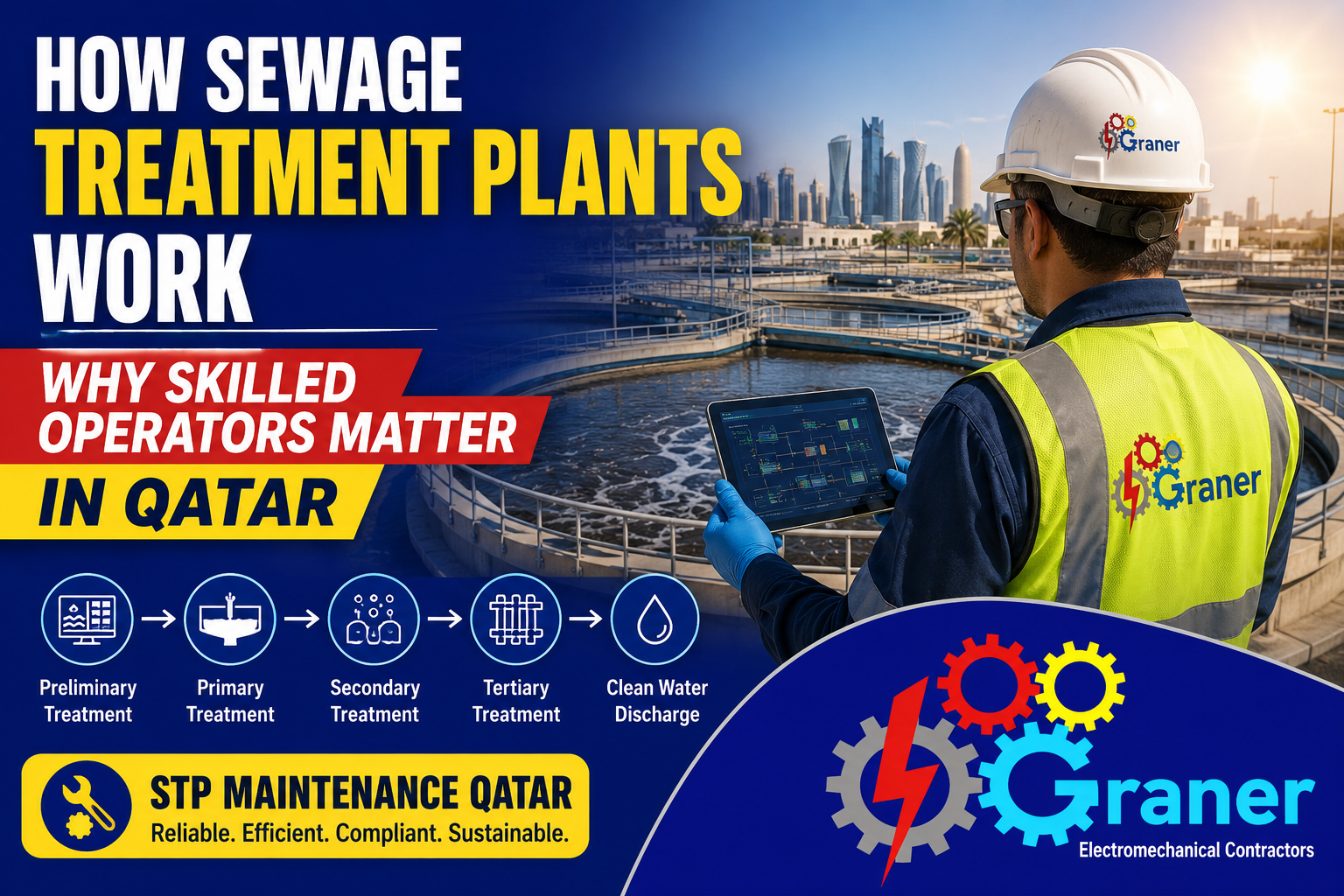
Qatar’s rapid urban expansion from Lusail City to the Doha Metro corridor has placed enormous pressure on its wastewater infrastructure. Behind every high-rise tower, commercial district, and industrial complex is a sewage treatment plant (STP) working around the clock to protect public health and the environment. But knowing how an STP works is only half the equation. The other half and the part most facilities get wrong is ensuring it is operated and maintained by the right people.
What Is a Sewage Treatment Plant?
A Sewage Treatment Plant (STP) is a facility that collects, processes, and purifies wastewater generated by households, commercial buildings, and industrial sites. The output is treated effluent that can be safely discharged into the environment or reused for non-potable purposes such as irrigation and cooling systems.
In Qatar, STPs are a critical piece of national infrastructure. With limited freshwater resources and strict environmental standards set by Ashghal (the Public Works Authority), proper sewage treatment plant maintenance in Qatar is not just a regulatory requirement — it is a matter of national sustainability.
Step-by-Step: How a Sewage Treatment Plant Works
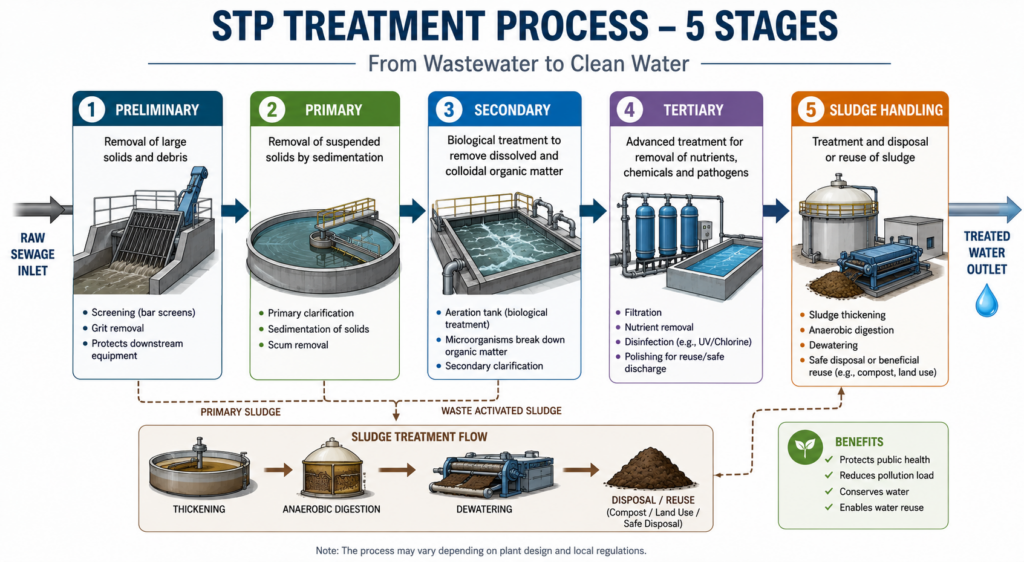
Stage 1 – Preliminary Treatment
The process begins with preliminary treatment, which acts as a physical barrier against large debris. Screens filter out solid objects such as plastics, rags, and other non-degradable materials. Grit chambers then remove heavier inorganic particles like sand and gravel.
This stage is often underestimated, but it is critical. Debris that bypasses screening will damage pumps, clog pipelines, and cause expensive equipment failure downstream. Proper screen maintenance is one of the first checkpoints during any STP operation and maintenance Qatar inspection.
Stage 2 – Primary Treatment (Sedimentation)
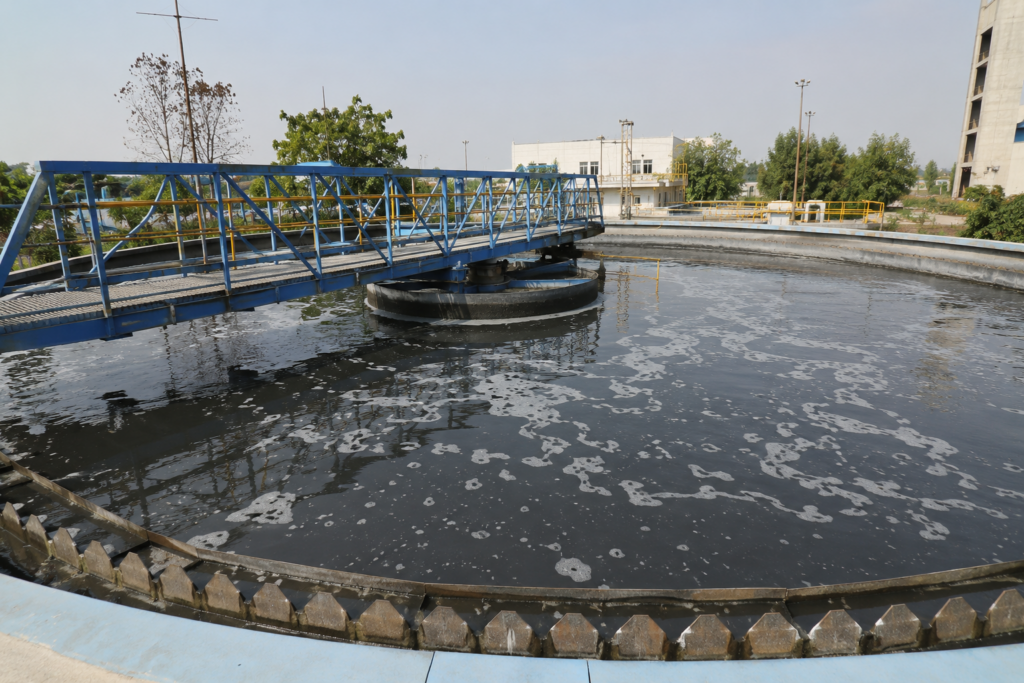
Wastewater next flows into primary sedimentation tanks, also called clarifiers. Here, the flow slows down deliberately, allowing heavier suspended solids to settle to the bottom as sludge, while lighter materials like grease and oil float to the surface and are skimmed off.
Primary treatment typically removes 50–70% of suspended solids and reduces BOD (Biological Oxygen Demand) by around 30%. The sludge collected at this stage is transferred to sludge handling for further processing.
Stage 3 – Secondary (Biological) Treatment
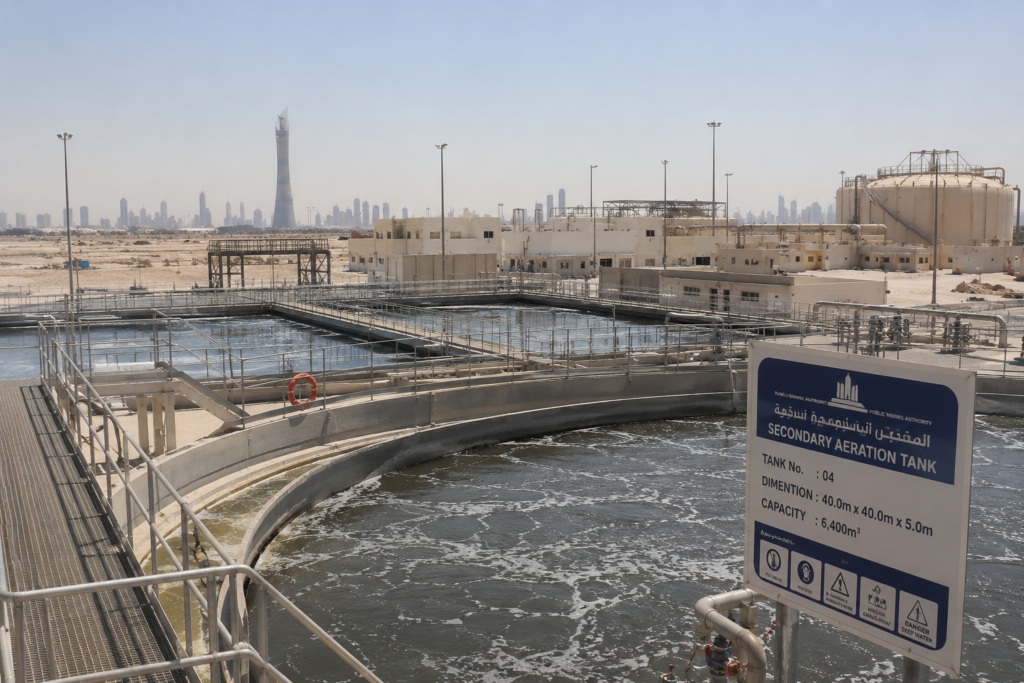
This is the core of the STP process and the most technically demanding stage to operate. Biological treatment uses living microorganisms to break down dissolved organic matter in the wastewater.
The most commonly deployed biological systems in Qatar include:
Activated Sludge Process (ASP): Wastewater is aerated in large tanks, promoting the growth of bacterial colonies that consume organic material. The resulting biomass is then separated in secondary clarifiers.
Sequential Batch Reactor (SBR): Ideal for sites with variable inflow, the SBR system operates in timed batches — fill, react, settle, decant — making it efficient for mid-scale plants.
Moving Bed Biofilm Reactor (MBBR): Biofilm grows on plastic carrier media suspended in the tank. MBBR systems are compact, resilient, and widely used in Qatar’s commercial and residential developments.
Membrane Bioreactor (MBR): The highest-quality output system, MBR combines biological treatment with membrane filtration. It is commonly specified in Qatar for projects where treated water will be reused.
Aeration is the lifeline of secondary treatment. Aerators must maintain dissolved oxygen levels above 2 mg/L at all times. Aeration blowers are among the highest-energy consumers in any plant and among the first things that degrade without consistent STP maintenance in Qatar.
Stage 4 – Tertiary Treatment (Effluent Polishing)
Tertiary treatment is the final purification stage before effluent is discharged or reused. It typically combines:
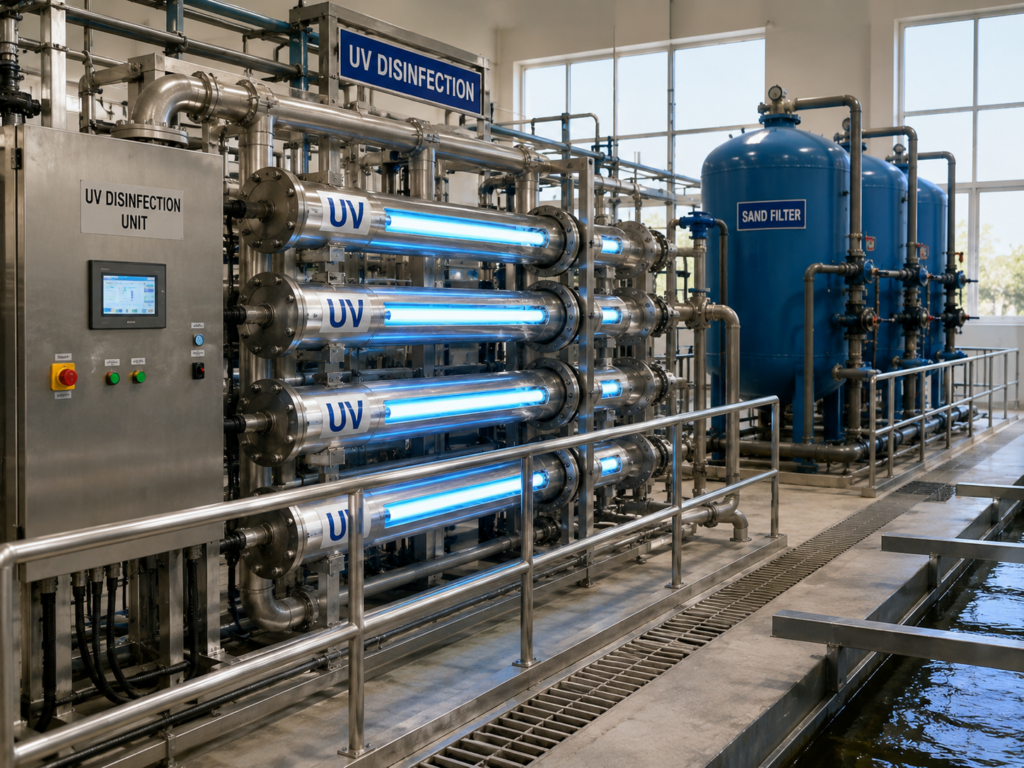
Filtration through sand beds or membrane systems to remove residual suspended particles.
Disinfection using UV light or chlorination to eliminate pathogens, bacteria, and viruses.
Nutrient removal (denitrification and phosphorus removal) to prevent environmental damage to groundwater and coastal areas.
In Qatar, where water scarcity makes treated water reuse a priority, tertiary treatment standards are increasingly rigorous. Ashghal’s effluent quality standards require strict compliance with parameters including TSS, BOD, COD, and coliform counts. Plants that skip or neglect tertiary maintenance risk regulatory penalties and public health incidents.
Stage 5 – Sludge Handling and Disposal
Every stage of the STP process generates sludge — a semi-solid byproduct of separated solids and biological mass. Sludge must be thickened, dewatered, and disposed of in compliance with Qatari environmental regulations.
Common sludge handling equipment includes:
Gravity thickeners to reduce water content before dewatering.
Screw press dehydrators or belt filter presses to mechanically remove moisture.
Sludge digesters in larger municipal plants to stabilize organic matter.
Sludge that is not managed properly creates odor problems, attracts pests, and can cause secondary contamination — one of the most common complaints associated with poorly maintained STPs in the region.
Qatar’s Unique STP Challenges – Why Standard Maintenance Is Not Enough
Operating an STP in Qatar is not the same as operating one in a temperate climate. Qatar’s environment creates specific stresses that require specialized knowledge and experience.
Extreme heat: Summer temperatures above 45°C accelerate biological activity, increase evaporation, and degrade membrane integrity. Aeration blowers and motors overheat faster, requiring more frequent inspection and lubrication.
High salinity in wastewater: Coastal and industrial zones in Qatar often see elevated salinity levels in incoming wastewater, which can disrupt microbial communities essential to biological treatment.
Sand and dust ingress: Fine particulate matter from the desert environment enters plant buildings and equipment, accelerating wear on filters, sensors, and mechanical components.
Rapid urbanization: New residential and commercial developments come online faster than maintenance contracts are established, leading to plants being operated without trained manpower from day one.
These realities make professional, Qatar-experienced STP services the difference between a plant that performs and one that fails.
What Skilled STP Operators Actually Do
Most facility managers know what an STP is supposed to do. Far fewer appreciate the technical depth required to keep one performing at specification. Skilled STP operators are responsible for:
Daily Monitoring: Checking flow rates, dissolved oxygen levels, pH, temperature, and MLSS (Mixed Liquor Suspended Solids) and knowing what deviations from baseline readings mean before they become failures.
Equipment Inspection: Inspecting pumps, blowers, aerators, chemical dosing systems, sludge handling units, and instrumentation on scheduled cycles.
Preventive Maintenance: Lubricating bearings, replacing worn parts, calibrating sensors, and cleaning diffusers before breakdown not after.
Compliance Reporting: Documenting effluent quality results and maintaining records required by Ashghal and Qatar’s Ministry of Environment and Climate Change.
Emergency Response: Diagnosing and responding rapidly when biological upsets, pump failures, or chemical imbalances occur which they will in any long-running plant.
This is not a role for unskilled labor. It requires trained technicians with practical STP experience, HSE certification, and familiarity with Qatar’s regulatory environment.
How Graner Supports STP Operation and Maintenance in Qatar
Graner Electromechanical Contractors has been providing technical workforce solutions across Qatar for years, with a strong track record in STP operation and maintenance Qatar projects. Graner’s STP services stand out for three core reasons:
Ashghal-Compliant Manpower: Every STP operator and technician supplied by Graner meets the compliance standards required by Qatar’s Public Works Authority. This ensures clients avoid regulatory exposure from day one.
Proven Project Portfolio: Graner has supplied plant operation teams, mechanical teams, and instrumentation teams for major STP projects including the Doha West sewage treatment plant operation (in partnership with SUEZ, starting February 2026) and Doha North sewage treatment support (Veolia). These are not entry-level assignments — they are Doha’s largest wastewater infrastructure projects.
End-to-End Flexibility: Whether a facility needs a complete STP operation team, a dedicated maintenance technician, or a specialized instrumentation engineer, Graner can mobilize the right resources quickly. This is especially valuable for facilities going through handover, startup commissioning, or contract transitions.
STP Maintenance Qatar: What a Proper AMC Should Include
If your facility is evaluating an Annual Maintenance Contract (AMC) for STP services in Qatar, here is what a comprehensive scope should cover:
Preventive Maintenance Schedule: Monthly, quarterly, and annual service visits covering all mechanical, electrical, and instrumentation components.
24/7 Emergency Callout: Sewage treatment plants do not stop at 5 PM. Your STP service provider should have technicians available around the clock.
Effluent Quality Reporting: Monthly laboratory testing and compliance reporting against Ashghal discharge standards.
Sludge Removal Coordination: Organized sludge dewatering and disposal in line with Qatar environmental regulations.
Spare Parts Management: A dedicated inventory of critical spares including blower bearings, diffuser membranes, dosing pump heads, and sensor probes to minimize downtime.
Operator Training: Onsite training for your facility management team on basic monitoring and emergency procedures.
Any STP services Qatar provider that cannot clearly define these deliverables should raise a red flag.
Frequently Asked Questions About STP Maintenance in Qatar
What is STP maintenance in Qatar?
STP maintenance in Qatar refers to the scheduled inspection, servicing, and operation of sewage treatment plant equipment and processes to ensure continuous, compliant performance. It includes mechanical maintenance, biological process monitoring, effluent testing, and sludge management.
Who regulates sewage treatment plants in Qatar?
Ashghal (the Public Works Authority) is the primary regulatory body overseeing STP design, operation, and effluent discharge standards in Qatar. The Ministry of Environment and Climate Change also governs environmental compliance.
How often should an STP be serviced in Qatar?
Critical components such as aeration blowers, pumps, and sensors should be inspected monthly at minimum. Full preventive maintenance checks should be conducted quarterly, with comprehensive annual overhauls.
What are the main types of STP systems used in Qatar?
The most common technologies used in Qatar are ASP (Activated Sludge Process), SBR (Sequential Batch Reactor), MBBR (Moving Bed Biofilm Reactor), and MBR (Membrane Bioreactor). Selection depends on plant capacity, space, and effluent reuse requirements.
Does Graner provide STP operation teams or just maintenance?
Graner provides both. From full plant operation teams covering all shifts to individual specialist roles (mechanical, electrical, instrumentation), Graner can structure its STP manpower services around each client’s specific contract requirements.
Can treated STP water be reused in Qatar?
Yes. Treated wastewater that meets Ashghal’s Class A or Class B effluent standards can be reused for irrigation, construction, and industrial cooling. Tertiary treatment with MBR or UV disinfection is typically required to reach reuse-grade quality.
Conclusion: Your STP Is Only as Good as the People Running It
A sewage treatment plant is a complex, interdependent system. Every stage — from screening to sludge dewatering — depends on the one before it. When any part of the process fails, the ripple effects are immediate: failed effluent tests, Ashghal penalties, odor complaints, equipment damage, and in worst cases, public health risk.
The technology inside an STP is standardized. What is not standardized is the quality of the people operating it. In Qatar’s competitive infrastructure environment, facilities that invest in trained, certified, experienced STP manpower consistently outperform those that treat operator staffing as an afterthought.
Graner Electromechanical Contractors delivers the human expertise behind high-performing STPs across Qatar — from Doha West to Doha North and beyond. If your facility needs reliable STP maintenance in Qatar, professional STP services, or a skilled operations team that meets Ashghal’s requirements from day one, Graner is ready to mobilize.
📞 Call Graner Today: +974 44366836
📍 Visit Our Office: No. 203, Barwa Commercial Avenue, Arkan Gate 23, 2nd Floor, Doha, Qatar
✉️ Get in Touch: Contact our team for reliable MEP, HVAC, STP, and Facility Management solutions across Qatar.